

Literature Against Adversity: Inside Lebanon’s “Dreaming Lebanon” Initiative
“Let the Walls Speak” – An Interview with Mrs. Nevine Toutounji-Hage Chahine, President of the “Dreaming Lebanon” Initiative
As jury members prepare to review submissions for the fourth edition of the “Dreaming Lebanon” Award, organized by Banque BEMO in partnership with the Ministry of Education and Higher Education, the Lebanese National Commission for UNESCO, the Institut français du Liban, Librairie Antoine, L’Orient-Le Jour, and Assabil Association, Mrs. Nevine Toutounji-Hage Chahine reflects on this year’s edition and its broader vision.
What is this year’s theme?
When we launched the fourth edition last October, we did not expect the theme to be so strikingly relevant: “Let the Walls Speak.” Let the walls speak of a country enduring wars it did not choose. Let the walls speak of a country marked by chaotic urban development. Let the walls speak of a country with so many urgent priorities that heritage preservation is often overlooked.
When Dr. Riad Obegi, Chairman and CEO of Banque BEMO, created this competition, his aim was to project Lebanese youth toward their future, while anchoring them deeply in their country, encouraging them—edition after edition—to rediscover its hidden treasures.
With this fourth edition, we wanted young participants to reconnect with both their local and national heritage. We hoped they would explore Roman, Phoenician, Crusader, or Umayyad ruins they pass by without noticing… and make the walls of their village churches, mosques, old cafés, and traditional olive presses speak again.
As a trilingual award, do you have three juries?
Unlike previous editions, which focused on specific literary formats such as letters or short stories, this edition invites participants to explore the literary richness of each of the three languages: Arabic, French, and English.
Walls will speak, whisper, cry out, or tell stories… in prose or poetry… in spontaneous lines or carefully crafted verses reminiscent of medieval troubadours. At least, that is my hope.
Despite the ongoing war, the “Dreaming Lebanon” team is currently reviewing hundreds of submissions. Each text is carefully examined before being sent to the juries.
All entries are anonymized: names, schools, and regions are hidden until final rankings are established. This ensures fairness and often leads to powerful emotional moments. In previous editions, we were deeply moved to award students from Ain Ebel in South Lebanon, even as they lived under bombardment.
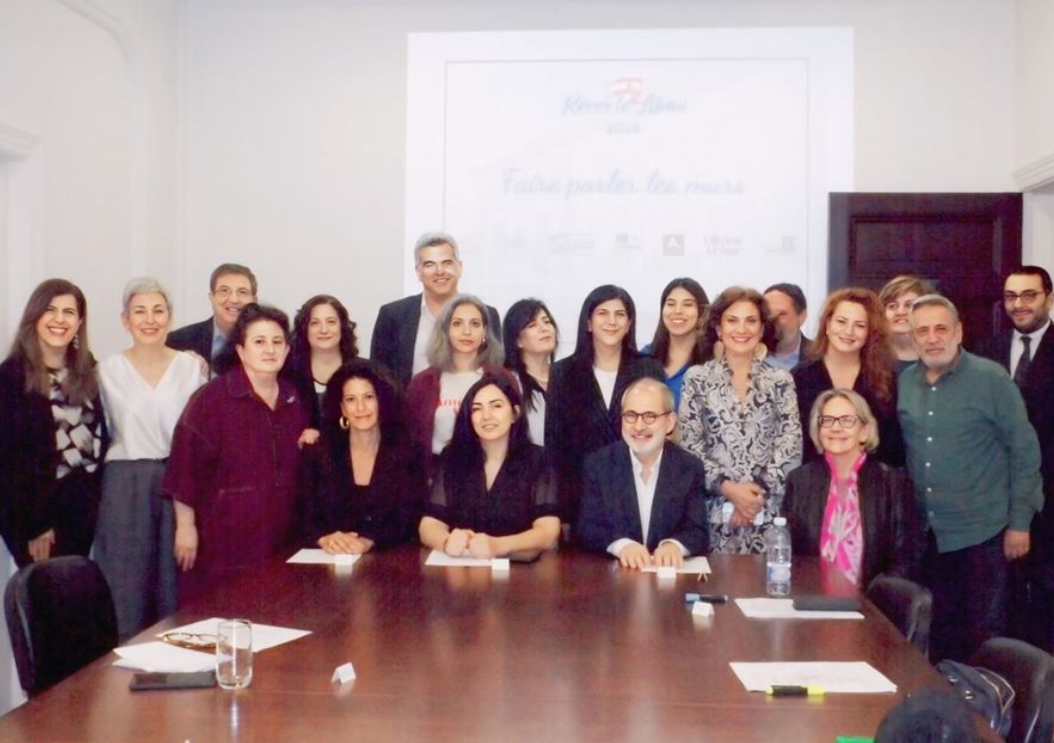
The juries are composed of individuals from diverse backgrounds, united by their commitment to Lebanon, its youth, and its future. I would like to acknowledge the dedication of former Bar President Amal Haddad, journalists Rosette Fadel and Maya Ghandour, poet Antoine Boulad, as well as civil society figures including Zeina Saleh, Ghina Achkar, and Dima Rifai.
What can you tell us about the candidates?
The candidates reflect the diversity of Lebanon itself. They come from Beirut, the South, the North, and the Bekaa. Many have been living for nearly two years under constant alerts and bombardments.
Some dream of leaving, while others know they have no choice but to stay. Some are fluent in English, others in French. Yet they all share a common aspiration: a normal life—turning on a tap and having water, flipping a switch and having electricity 24/7.
This aspiration has remained unchanged. And this year, perhaps, the walls themselves will dream of lasting peace.
How do you address the rise of artificial intelligence?
This is a broad issue. We have made it clear to candidates that we want to read them—not a machine. We may be among the last generations who relied on heavy dictionaries to discover new words. Today, everything is accessible instantly. But this ease can be dangerous if it turns knowledge into fast consumption without depth or guidance.
This is where parents and educators play a crucial role. The competition rules allow the use of artificial intelligence up to a maximum of 15% of the text. Detection tools are used when needed, and since 2025, all submissions have been individually verified.
When will the awards be presented?
The award ceremony is scheduled for April 25. The anthology of selected texts, published in partnership with Librairie Antoine, will be released in October 2026. Of course, this is a timeline for times of peace… But we continue to dream—and to hope.
The main interview was conducted in French with journalist Zeina Saleh and was originally published in L’Agenda Culturel.